This Is the Last Golden Week: A Ginkgo Loop Around Gyeongbokgung Palace and a Coin Lunchbox at Tongin Market
Contents
For most of the year, Seoul's ginkgo trees are just street trees. Then, for a few short days in autumn, the whole city turns yellow. Those days are happening right now.
The Seoul city government expects this year's fall colors to last through mid-November. On top of that, Gyeongbokgung and the other main royal palaces are free to enter until November 15. This weekend is the last one where golden ginkgo trees and free palaces overlap.
So I picked one route that shows off Seoul's ginkgo trees better than anywhere else. It loops around the stone walls of Gyeongbokgung Palace, and whenever you get hungry, there's a market right next door.
The short version
- The best ginkgo streets are Hyoja-ro on the palace's west side and Samcheong-ro on the east side
- Have lunch at Tongin Market with a coin lunchbox, and grab oil tteokbokki as a snack
- Free entry to Gyeongbokgung runs until Sunday, November 15, and the palace is closed on Tuesdays
- Bukchon Hanok Village is open to tourists only from 10 a.m. to 5 p.m.
- Take subway Line 3 to Gyeongbokgung Station or Anguk Station
Why this week?
Three reasons.
- The ginkgo trees are at their yellowest. The ginkgo trees on Hyoja-ro were about 80% yellow by the end of October, and the city said downtown foliage would peak through early to mid-November. Right now you can see yellow leaves on the branches and a yellow carpet on the ground.
- The palaces are free. As part of the Korea Grand Festival, the Korea Heritage Service opened Gyeongbokgung, Changdeokgung, Changgyeonggung, Deoksugung, and the Jongmyo Shrine for free from October 29 to November 15. This weekend is the last chance.
- There's plenty to do after dark. The National Palace Museum of Korea stays open until 9 p.m. on Saturdays, and the Seoul Museum of Craft Art near Anguk Station has extended evening hours through November 30.
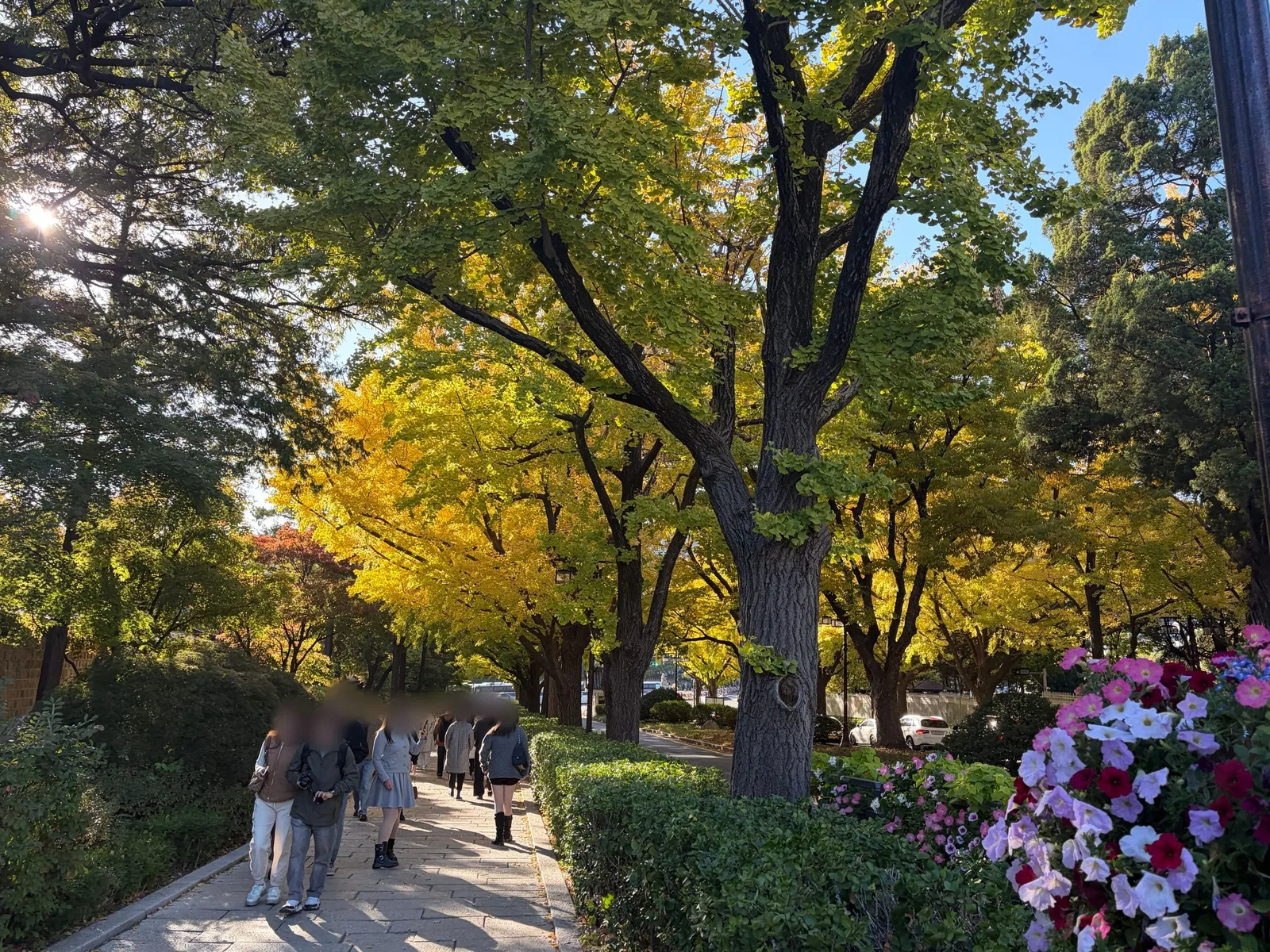
This is a ginkgo street beside the palace wall. Yellow leaves and still light-green ones are mixed together, so the colors shift a little with every step.
The route at a glance
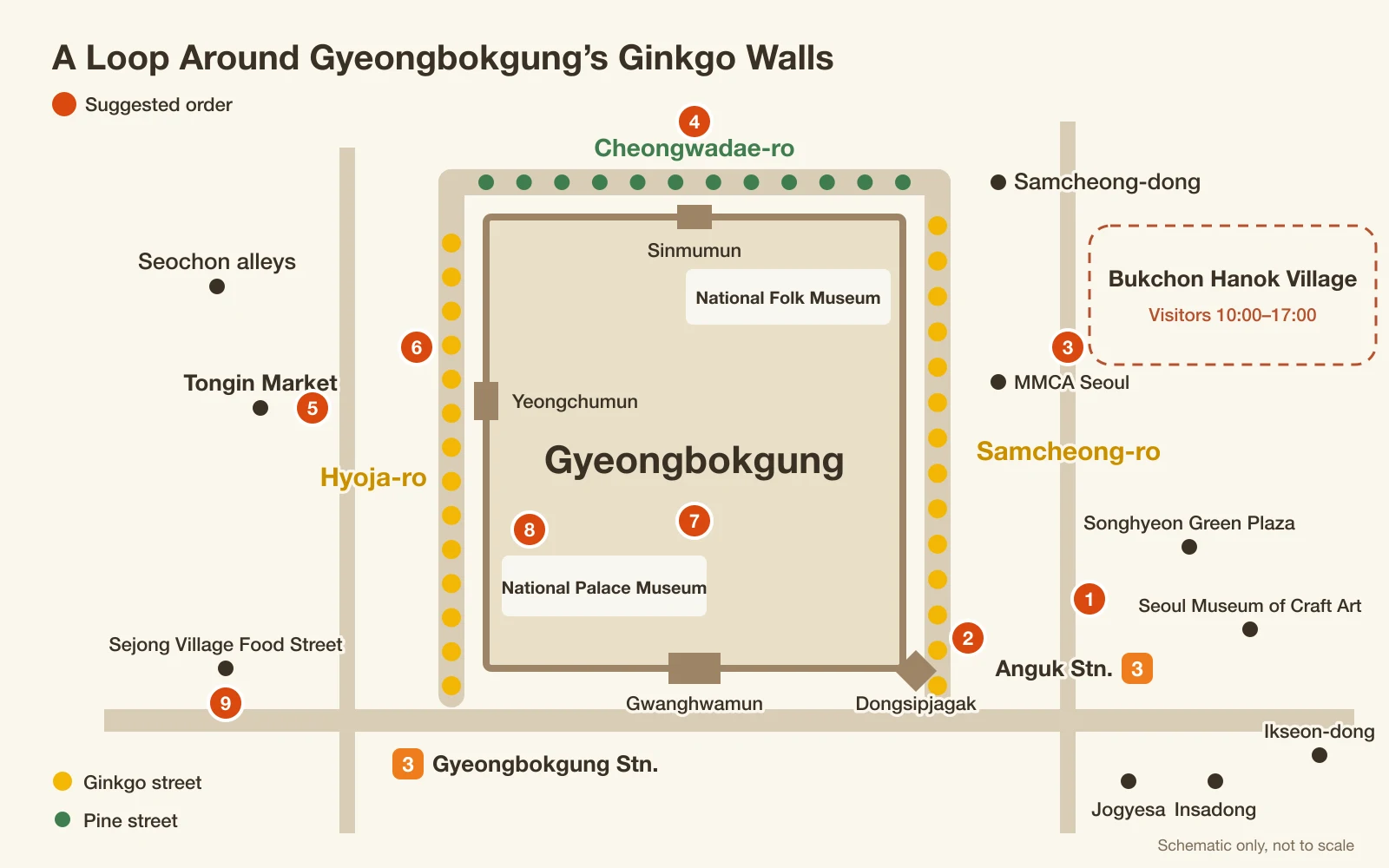
The walk follows the palace walls along Samcheong-ro on the east, Cheongwadae-ro on the north, and Hyoja-ro on the west. It's one of the downtown routes in the city's list of 110 autumn foliage walks.
| Section | What it's like |
|---|---|
| Samcheong-ro (east) | Ginkgo trees taller than the wall, like a yellow roof on the stones |
| Cheongwadae-ro (north) | A quiet stretch where pine trees guard the wall instead of ginkgo |
| Hyoja-ro (west) | The busiest ginkgo photo spot around the palace |
| Inside the palace | With free entry this week, you can see both sides of the wall |
You can walk the whole loop, but if you're short on time, skip Cheongwadae-ro. Walking past the front of Gwanghwamun Gate quickly links the southern ends of Samcheong-ro and Hyoja-ro.
East side: from Anguk Station to Samcheong-ro
Songhyeon Green Plaza and the Seoul Museum of Craft Art
Right outside Anguk Station is Songhyeon Green Plaza. For more than 110 years, this land was hidden behind tall walls, until the city opened it to the public in 2022. Autumn flowers are blooming there now, so it's a nice warm-up before the walk. The Seoul Museum of Craft Art is right across the street, and a little to the south, Jogyesa Temple is holding a chrysanthemum festival.
From Dongsipjagak to Samcheong-ro
Dongsipjagak is the old watchtower at the southeast corner of the palace. Head north from there and you're on Samcheong-ro. The ginkgo trees here have grown taller than the palace wall, so they look like a yellow roof on top of the stones. Don't miss the fall colors peeking over the wall of the National Museum of Modern and Contemporary Art (MMCA Seoul), or the ginkgo tree in front of the National Folk Museum of Korea's main gate.
Samcheong-ro leads to Samcheong-dong, a neighborhood full of cafés and galleries. Grab a coffee, then keep heading north, or duck into the alleys to the east for Bukchon Hanok Village.
Visit Bukchon before 5 p.m.
Bukchon is a hanok (한옥, traditional Korean house) village where people actually live. That's why tourists can enter the area around Bukchon-ro 11-gil in Gahoe-dong only between 10 a.m. and 5 p.m. Outside those hours, you can be fined 100,000 won (about 70 USD). Shop customers and guests staying in the area are exempt, but if you're just sightseeing, go during the day. Keeping your voice down in the alleys is good manners.
North side: Cheongwadae-ro
Turn west from Samcheong-dong and you'll reach Cheongwadae-ro, in front of Sinmumun, the palace's north gate. Here, pine trees guard the wall instead of ginkgo. It's a green break between the yellow streets, with Bugaksan Mountain rising behind it.
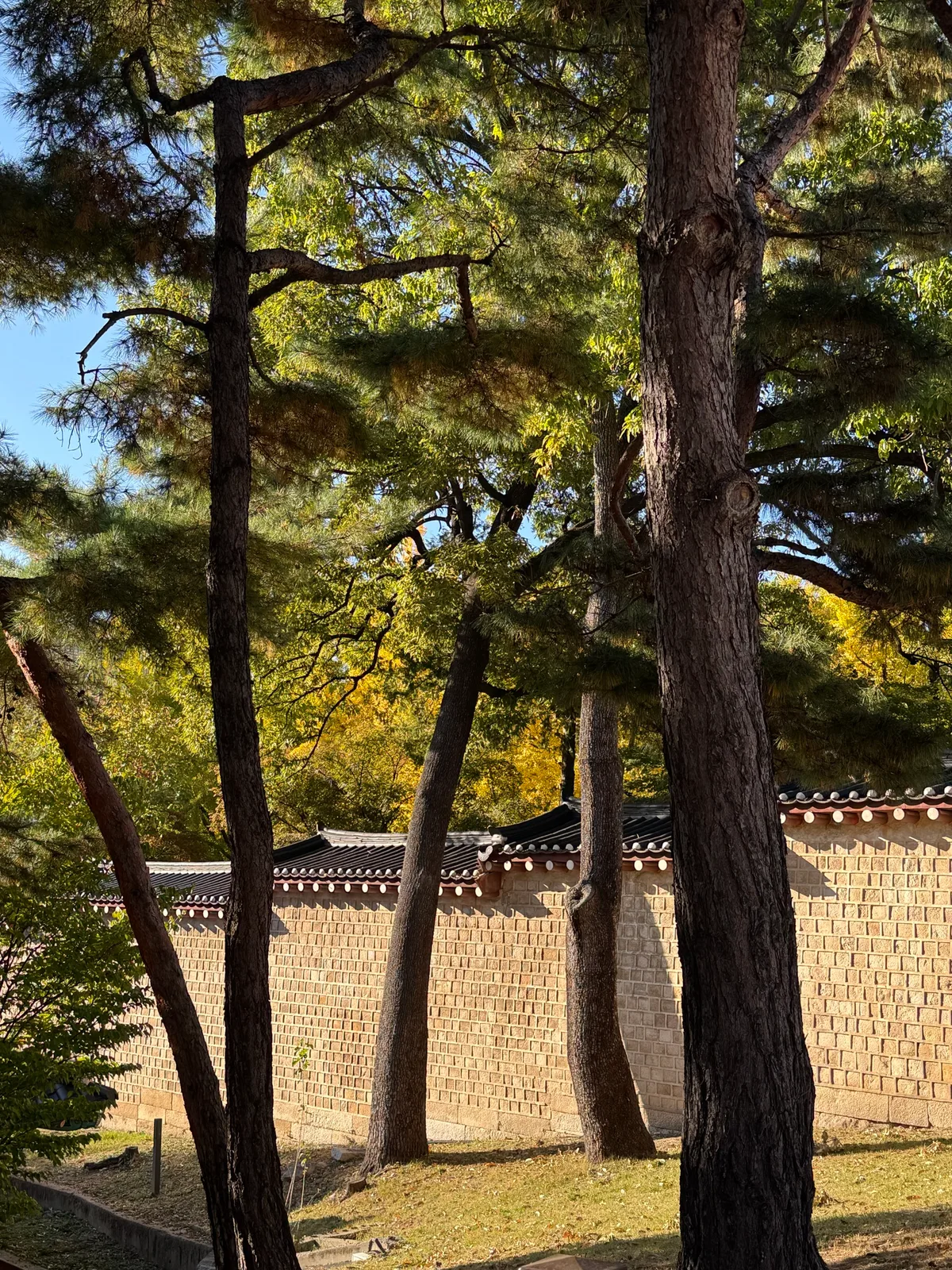
This is what pine trees and the palace wall look like together. Between the green pines, you catch glimpses of yellow ginkgo on the other side of the wall.
In May this year, a new 4.3 km garden walk opened, linking the palace to Samcheong-ro, Hyoja-ro, and Cheongwadae-ro. Note that the grounds of Cheong Wa Dae, the former presidential office, have been closed since August 2025, so you can't go inside.
West side: the Hyoja-ro ginkgo street
This is the highlight of the route. Hyoja-ro is the most popular photo spot around Gyeongbokgung, and a city article called it the hottest street around the palace these days.
- Yeongchumun Gate: This is the palace's west gate. It's where you'll find the shadows of ginkgo trees falling on the stone wall. Hyoja-ro runs along the west side of the wall, so in the afternoon, when the sun is low in the west, the shadows fall onto the wall.
- The National Palace Museum entrance: Walk south along Hyoja-ro and you'll find a huge ginkgo tree covering the museum entrance. Walk straight in.
Take a break at the National Palace Museum
Both the permanent and special exhibitions at the National Palace Museum of Korea are free. Right now, it's running a special exhibition called Dokdae: The Eight Characters Left by Ahn Jung-geun, which shows, for the first time in public, a piece of calligraphy by Korean independence activist Ahn Jung-geun, written shortly before his execution. It runs until December 27.
| Day | Hours |
|---|---|
| Mon–Fri, Sun | 9:30–17:30 |
| Saturday, last Wednesday of the month | 9:00–21:00 |
On Saturdays it stays open until 9 p.m., so it's a warm place to rest after sunset.
Eating in the markets and alleys
The Tongin Market coin lunchbox
All that walking will make you hungry. Walk a little west from Hyoja-ro and you'll reach Tongin Market.
Tongin Market is famous for its yeopjeon dosirak (엽전도시락, coin lunchbox). At the lunchbox café inside the market, you buy old-style brass coins worth 500 won each and get an empty lunchbox tray. Then you walk around the market stalls, paying with coins and filling your tray one side dish at a time. Picking your own menu is half the fun, which makes it great for first-time visitors.
For a snack, try gireum tteokbokki (기름떡볶이, oil tteokbokki). Instead of the usual saucy version, the rice cakes are stir-fried in oil with no broth. It's the market's signature dish.
The market is open roughly from 7 a.m. to 9 p.m., and closing days vary by stall. Lunchtime is the best time for the coin lunchbox, when the side dish stalls are open.
The Seochon alleys
Seochon, the neighborhood around Tongin Market, is full of small restaurants and cafés. The area from Jahamun-ro 7-gil to Ogin-gil is the heart of Seochon's shopping streets.
If you're curious about Korea's latest dessert trends, stop by a mochi shop in Seochon too. I introduced one that sells rice cakes filled with dujjonku-style filling in an earlier post.
Sejong Village Food Street
For dinner, try Sejong Village Food Street, right next to Exit 2 of Gyeongbokgung Station. It's an alley of Korean barbecue spots, Japanese restaurants, and beer pubs, on the site of the old Geumcheongyo Market. It's a good place to rest your legs after a full day of walking.
Ending in the east: Insadong and Ikseon-dong
If you finish your day near Anguk Station, head south to Insadong, or to Ikseon-dong near Jongno 3-ga Station. Insadong is full of traditional craft shops and teahouses, and Ikseon-dong has alleys of restaurants and cafés in renovated hanok houses.
A suggested one-day plan
With Bukchon's visiting hours and the direction of the sun in mind, the easiest order is to start in the east, go counterclockwise, and finish in the west.
| Time | What to do |
|---|---|
| 10:00 | Arrive at Anguk Station, stroll around Songhyeon Green Plaza |
| 10:30 | Walk north from Dongsipjagak along the Samcheong-ro ginkgo street |
| 11:30 | Explore Samcheong-dong and Bukchon Hanok Village |
| 12:30 | Head west along Cheongwadae-ro |
| 13:00 | Lunch at Tongin Market: coin lunchbox and oil tteokbokki |
| 14:00 | Rest at a café in the Seochon alleys |
| 15:00 | Walk south along Hyoja-ro and take photos in the afternoon light |
| 15:30 | Free entry to Gyeongbokgung (closes at 17:00) |
| 16:30 | Visit the National Palace Museum (open late on Saturdays) |
| 18:00 | Dinner at Sejong Village Food Street |
Good to know before you go
- Closing days: Gyeongbokgung closes on Tuesdays. Changdeokgung, Changgyeonggung, and Deoksugung close on Mondays. All are open this weekend.
- Gyeongbokgung hours: 9:00–17:00 in November.
- Changdeokgung's Secret Garden (Huwon): It's not part of the free entry, so you need a separate reservation and ticket.
- Subway: Use Gyeongbokgung Station (Line 3) for the west side and Anguk Station (Line 3) for the east side. Exit 5 of Gyeongbokgung Station leads straight toward the palace and the National Palace Museum.
- Parking: The Gyeongbokgung parking lot charges 3,000 won for the first hour for a small car, then 800 won for every 10 minutes. On weekends, the subway is much easier.
- Ginkgo fruit smell: Ginkgo trees in busy spots, such as near crosswalks and traffic lights, have nets to catch the fruit, and fallen fruit gets cleared quickly. You don't need to worry much about the smell.
Golden Seoul won't wait
Once ginkgo trees turn yellow, they drop their leaves fast. By next week, the same streets will look completely different.
If you're in Seoul this weekend, get off at Gyeongbokgung or Anguk Station and follow the palace walls. Walk through the yellow tunnels, then pick your lunch with a handful of coins, and you'll see right away why this is the season to walk Seoul.
The map and the cover image are my own illustrations. The map only shows how places relate to each other and isn't to scale. Foliage conditions, free entry, and opening hours are based on information from the Seoul city government and each institution, checked on November 12, 2026. Please double-check the Seoul autumn foliage guide and each institution's website before you go. This post was originally written in Korean and translated into English.